Architecture
Why authentication starts with a port
A provider should be replaceable without asking the rest of your application for permission.
Application code
AuthPort
The stable contract
getSession · signIn · signOut · requireUser
Every authentication integration looks simple—until it is not. The SDK leaks across your codebase, a migration turns into a scavenger hunt, and your quick provider swap becomes a quarter of careful rewrites.
In Micropreneur Starter Pro, authentication is a replaceable capability behind a port. The rest of the application depends on a small contract, not a vendor. Adapters live at the edge.
The boundary is the product
A port is the application's way of saying, "Here is what I need. You decide how." Our
AuthPort defines the use cases the app cares about—session, user, sign in, sign out—and
nothing more.
That boundary gives every fork:
- Freedom to change providers without touching product code.
- Testable application logic with no authentication SDK in sight.
- A smaller surface area for agents and humans to understand.
- Clear ownership when an integration needs to change.
It is deliberately boring. That is the point.
If application code imports a provider SDK outside the adapter, you do not have a boundary—you have a leak.
A small contract
The contract is short enough to understand in one screen and broad enough to support the app shell:
export interface AuthPort {
  getSession(request: Request): Promise<Session | null>
  getUser(request: Request): Promise<User | null>
  requireUser(request: Request): Promise<User>
  signIn(input: SignInInput): Promise<SignInResult>
  signOut(request: Request): Promise<void>
}
Notice what is absent: provider-specific cookies, SDK response types, and product-specific permissions. Those details belong on the other side of the boundary.
| Concern | Application | Adapter |
|---|---|---|
| Current user | Calls getUser() | Reads the provider session |
| Protected route | Calls requireUser() | Redirects or returns the user |
| Sign in | Sends a typed input | Translates it for the provider |
| Sign out | Requests the capability | Clears provider state |
The table is more than documentation. It is a test for where new behavior belongs.
Adapters live at the edge
Starter ships with Better Auth as the working default and Descope as the typed enterprise seam. Both implement the same port, so the composition root can select one without teaching the application a second vocabulary.
- The route asks the port for a user.
- The selected adapter talks to its provider.
- The adapter returns the shared domain shape.
- The route renders without knowing which provider answered.
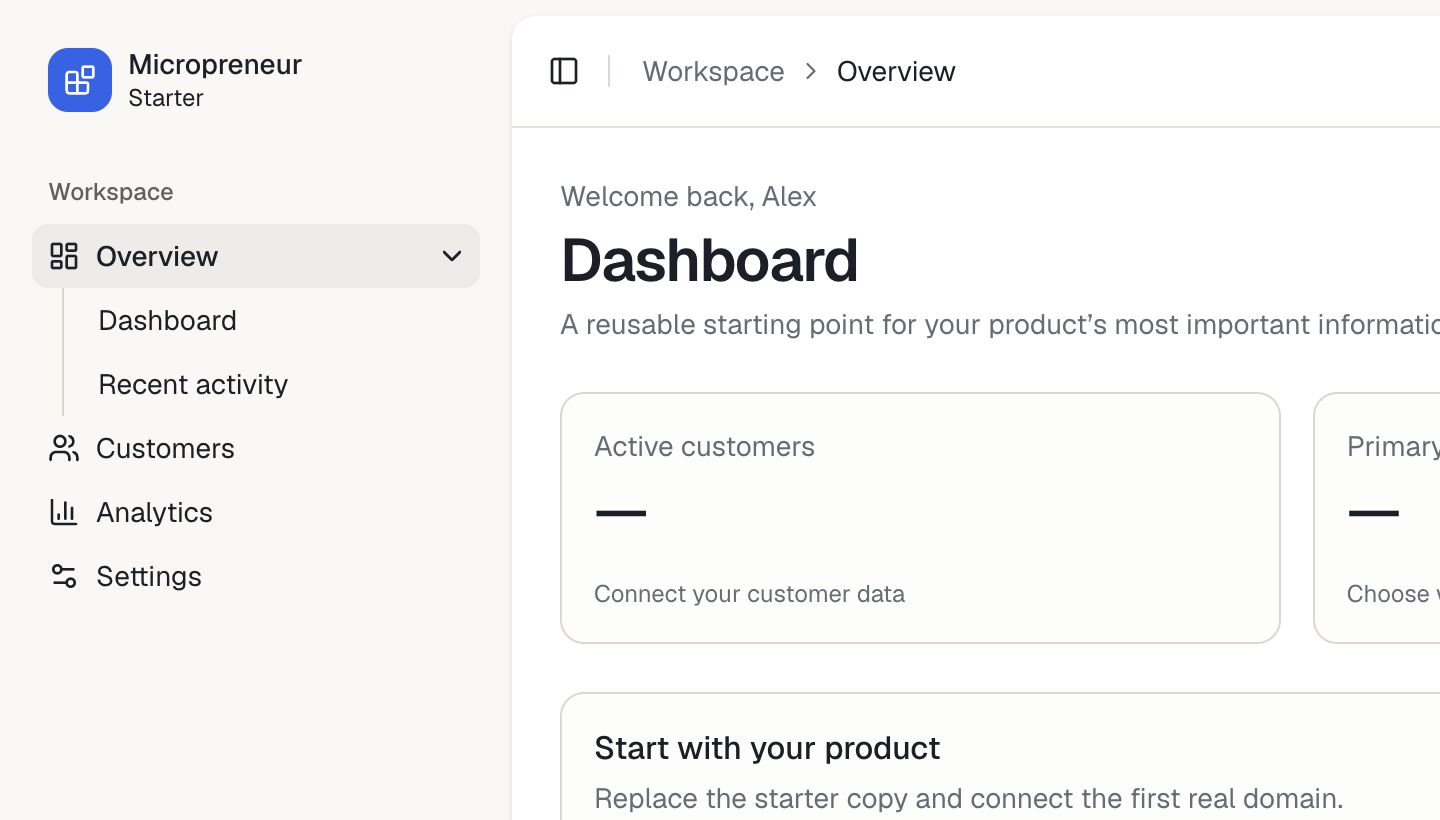
The application shell consumes the shared user shape; provider details remain outside it.
This separation also improves the local loop. A test can supply a tiny in-memory adapter, while the real Better Auth adapter works against local D1. Each layer gets the feedback it needs without pulling the whole stack into every test.
What changes in a fork
Most projects should keep the default and start building their product. When a fork genuinely needs a different identity platform, the change stays bounded:
- Implement
AuthPortin a new adapter. - Map provider data into the shared
UserandSessionshapes. - Add focused contract tests.
- Select the adapter in the composition root.
- Leave routes, UI, and domain code alone.
That is the leverage of a good seam. It does not promise that providers are identical. It makes their differences explicit, local, and replaceable.
The best architecture in a starter is not the one with the most abstractions. It is the one that lets the next project become itself without first fighting the foundation.
Read next
The local loop is part of the starter
Short, deterministic feedback loops are part of the product—especially when humans and coding agents share a repository.